 CN


Welcome to call for consultation
Professional technical consultants are at your service 24 hours a day!
 0519-86153308
 czhddl@163.com
Contact Us

 Page views:Update time:
 Product Introduction
Process Principle
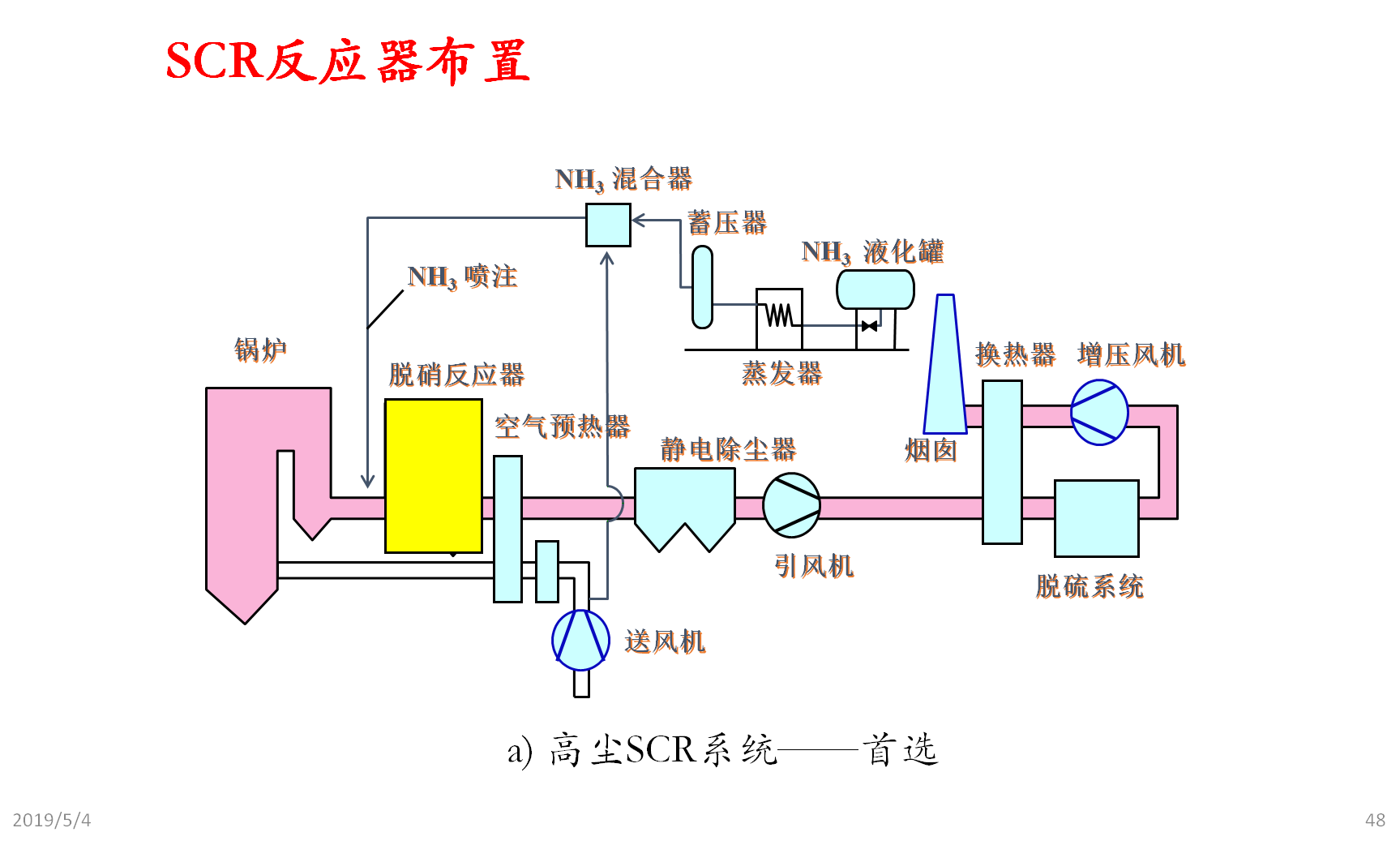
Selective Catalytic Reduction (SCR) technology is a widely used and effective flue gas denitrification technology at present. With the action of a metal catalyst, the reducing agent (NH₃) reacts with nitrogen oxides in flue gas to generate harmless nitrogen (N₂) and water (H₂O), so as to remove nitrogen oxides (NOₓ) from flue gas. "Selective" means that the reducing agent (NH₃) undergoes a reduction reaction with NOₓ in the flue gas instead of reacting with oxygen (O₂) in the flue gas. The denitrification efficiency of this process can reach 80-90%, the ammonia slip can be controlled at 3 ppm, the equipment availability is high, and there is basically no secondary pollution.
Inside the SCR reactor, NO is reduced through the following reactions:
4NO+4NH₃+O₂ → 3N₂+6H₂O (1)
6NO+4NH₃ → 5N₂+6H₂O (2)
When oxygen exists in the flue gas, Reaction (1) takes precedence. Therefore, the ammonia consumption has a one-to-one relationship with the amount of NO reduced.
In boiler flue gas, NO₂ generally accounts for about 5% of the total NOₓ concentration. The reactions involving NO₂ are as follows:
2NO₂+4NH₃+O₂ → 3N₂+6H₂O (3)
6NO₂+8NH₃ → 7N₂+12H₂O (4)

Previous: SNCR flue gas denitrification
 Online Message

Welcome to call for consultation
Professional technical consultants are at your service 24 hours a day!
0519-86153308
czhddl@163.com
Contact Us
 Product Center
 Related Articles